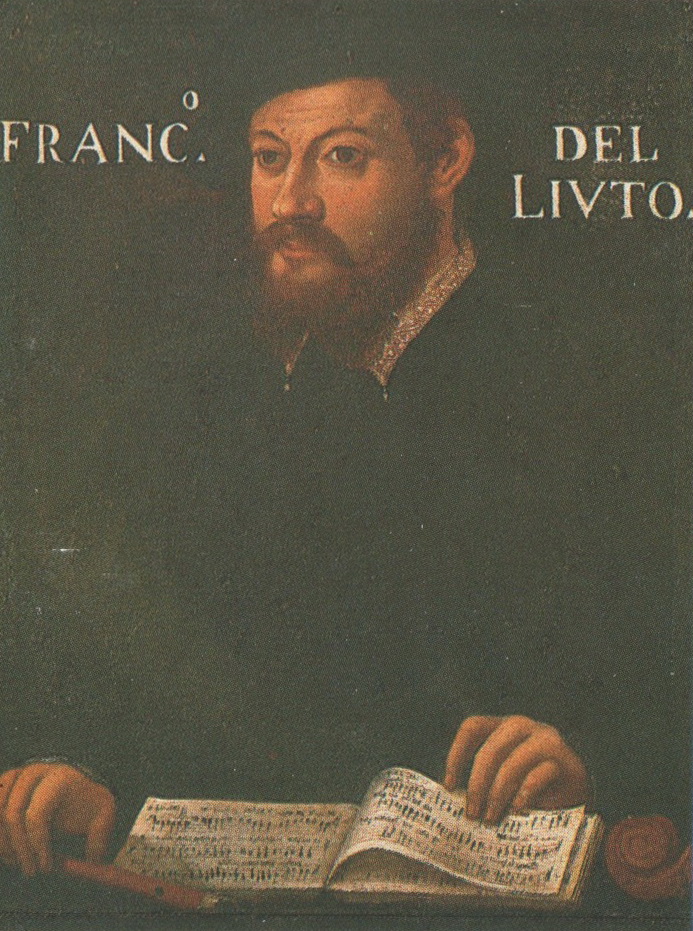
His contemporaries called him ‘Il divino’, ‘a miraculous lute player’, he was the most famous lutenist of the Renaissance…There are many descriptions of Francesco’s consummate skill as a performer, those that heard him were transfixed by the ‘angelic sound of the divine Francesco’. None, however, is more telling than that of Pontus de Tyard, who in describing the powers of music, relates the story told him by Jacques Descartes de Ventemille of a performance by Francesco:
‘Music is the sovereign mistress for solacing grief, appeasing wrath, curbing boldness, tempering desire, healing sorrow, easing the misery of poverty, dispelling weakness, and soothing the pangs of love. You could relate a great number of ancient stories on this subject, but you would hardly find one of a more striking proof than that which was recently told us to the same end by Monsieur de Ventemille… who while staying in Milan… was invited to a sumptuous banquet given in honour of one of the most illustrious groups of the city and in the house of the same elegance where, among other pleasures of rare things assembled for the happiness of these select people, appeared Francesco da Milano – a man who is considered to have attained the end (if such is possible) of perfection in playing the lute well. The tables being cleared, he chose one, and as if tuning his strings, sat on the end of a table seeking out a fantasia.
He had barely disturbed the air with three strummed chords when he interrupted conversation which had started among the guests. Having constrained them to face him, he continued with such a ravishing skill that little by little, making the strings languish under his fingers in his sublime way, he transported all those who were listening into so pleasurable a melancholy that – one leaning his head on his hand supported by his elbow, and another sprawling with his limbs in careless deportment, with gaping mouth and more than half closed eyes, glued (one would judge) to those strings (of the lute), and his chin fallen on his breast, concealing his countenance with the saddest taciturnity ever seen – they remained deprived of all senses save that of hearing, as if the spirit, having abandoned all the seats of the senses, had retired to the ears in order to enjoy the more at its ease so ravishing a harmony; and I believe (said M. de Ventemille) that we would be there still, had he not himself – I know not how – changing his style of playing with a gentle force, returned the spirit and the senses to the place from which he had stolen them, not without leaving as much astonishment in each of us as if we had been elevated by an ecstatic transport of some divine frenzy.’